
Yes. We service and repair compactors you already own, whatever the brand and whoever installed it, and we haul the compacted loads. When a unit finally reaches the end of its working life we will quote a replacement, purchased or leased, and handle the installation. Grocery stores, distribution centers, manufacturers and retail operations around Wilson run equipment we maintain.
Owning the unit changes nothing about what we can do with it. If anything, it is the more common situation.
A great many of these units arrived with the building.
An operation takes over a lease and inherits whatever is on the pad. A business changes hands and the equipment comes with it. Somebody bought a compactor outright eight years ago from a company that has since been acquired, moved, or simply stopped answering. The unit still runs, nobody has a manual for it, and the only service history is whatever the last maintenance person remembers.
That is a normal starting point rather than a complication. Make and vintage are not obstacles, and the compactor service Wilson NC operations need does not depend on who sold the machine or how long ago.
Compactor service Wilson NC businesses book from us covers three separate things, and they are worth keeping apart because operations often want one and not the others.
Scheduled maintenance. Routine attention before something fails — checking hydraulics and seals, the ram and platen, the electrical side, and the general condition of a compactor that lives outdoors and runs every working day.
Repairs. Hydraulic leaks, motor faults, relay and limit switch problems, worn seals, a ram that has stopped cycling cleanly. These are the common ones.
Hauling. We pull the compacted load and bring the container back. That part works the same whether the compactor is ours or yours.
You can take all three or any one of them. Plenty of Wilson operations have us on compactor maintenance and hauling while keeping their own people for the small fixes, and that is a perfectly workable arrangement.
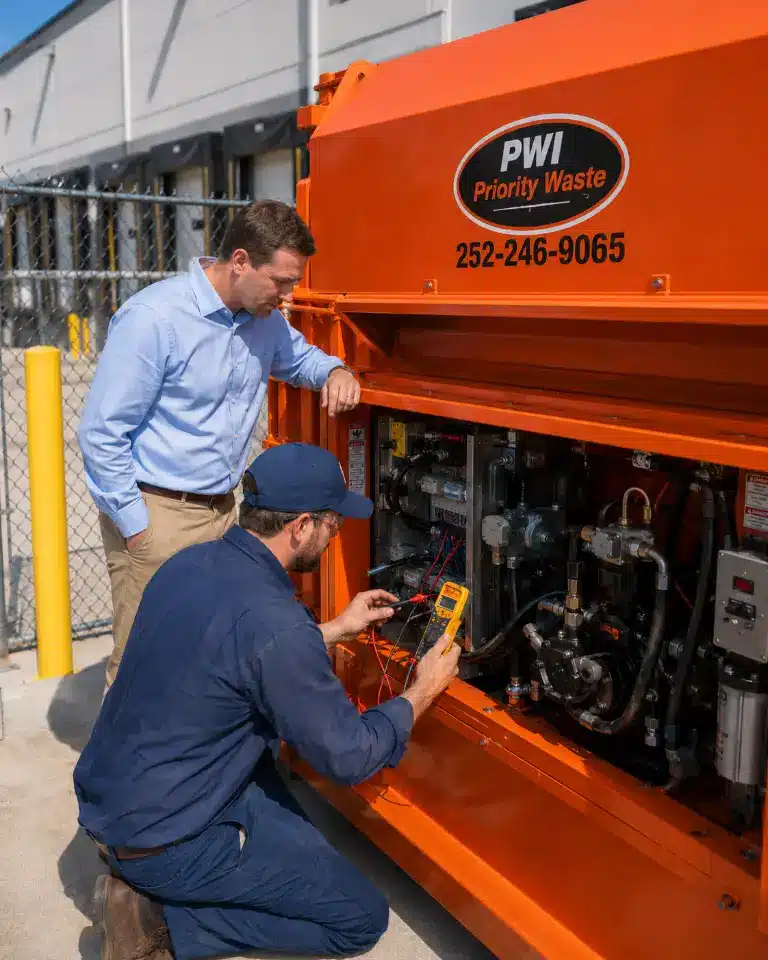
This is the question underneath the question, and it deserves a straight answer rather than a sales one.
Usually it is worth repairing. Hydraulic and electrical faults are the bulk of what goes wrong on a compactor, and most of them are a component problem rather than a machine problem. A unit that has been maintained can run a very long time, and replacing it because one system failed is an expensive way to solve a cheap issue.
Replacement comes into view when the failures stop being about components. Structural corrosion through the walls or the floor. A chassis that is going. Repeated faults turning up across different systems rather than the same one twice. Parts for an older machine becoming genuinely difficult to source. That pattern is the signal, far more than any single breakdown.
The honest summary is that one failure almost never means a unit is finished. Three failures in three different places over a year usually does, and at that point the money spent keeping it alive is better spent elsewhere.
We will tell you which of those you are looking at. There is no benefit to us in replacing a compactor that has years left in it, and an operation that gets pushed into an unnecessary purchase does not call us again.
Replacement runs either way — purchased outright or leased — and which suits you is a question about your own capital planning rather than about the equipment.
What we would want to understand first is whether a like-for-like swap is actually right. The operation that bought the original unit may not be the operation you are running now. Volume changes, waste streams change, and a self-contained unit, a stationary one, or a vertical unit may suit the building differently than it did when the first machine went in. Replacing the unit is one of the few moments where it costs nothing to ask whether the original choice still fits.
Installation is ours. Removing the old compactor, siting and setting the new one, and getting it running are all part of the job.
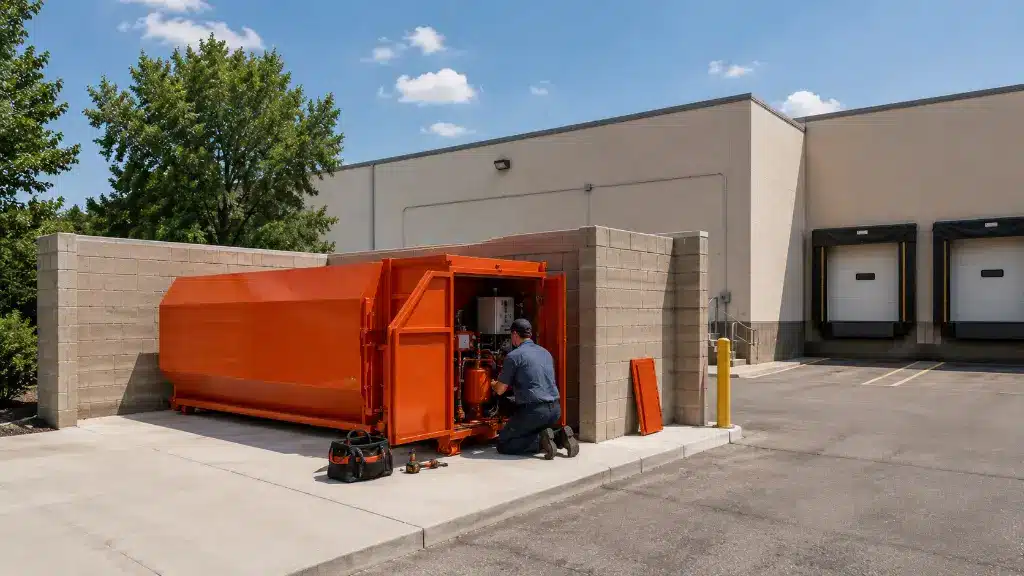
This matters more than it sounds, because a compactor is fixed capital bolted to a pad, and the site decides how quickly anyone can get to it.
The heaviest concentration sits in and around Hackney Industrial Park on US-264 Alt, and south of the city at the Wainwright and Turnage parks — manufacturers, distribution operations, food processors, ag suppliers. The second concentration is retail and grocery along Ward Boulevard, where units sit behind the stores on tight service aprons. Downtown has its own version of the problem, with equipment wedged into back lots behind buildings that were never laid out for it.
Each of those sites behaves differently when something goes wrong. A dock in an industrial park has room for a service truck. A grocery apron on a Saturday does not. A downtown back lot may need the approach cleared before anyone can work.
The practical consequence is that the useful conversation happens before a failure rather than during one. The compactor crew works out of the same yard as everything else on our Wilson location page.
The route does not stop at the city limits. Operations out in Stantonsburg and Black Creek, in Bailey and Lucama, in Sims and Elm City and Drivers Store, run compactors too — often a single unit at a single site, with nobody on staff who works on them.
Those are the customers for whom a local service relationship matters most, because the alternative is waiting on a technician dispatched from somewhere considerably further away.
The make if you know it, roughly how old the compactor is, what it is doing or failing to do, and where it sits. If there is service history, that helps. If there is not, which is common, we will work from the machine itself.
Call (252) 246-9065 and tell us what you have. Describe the unit and what it is doing, and we will tell you whether it needs a technician, a maintenance schedule, or a straight conversation about replacing it.